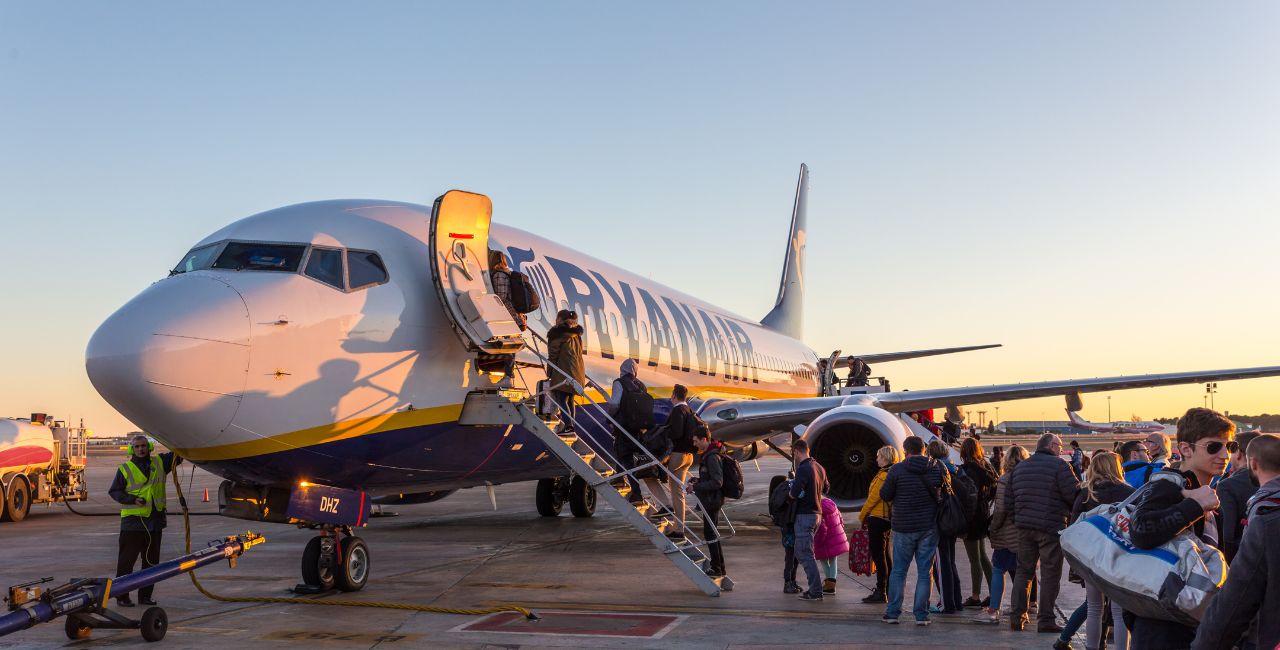

There must be a better way to do this, surely.
I’m hardly the first person to think this while stuck behind a seemingly endless line of people waiting to board an airplane. If this question hasn’t crossed your mind yet, wait till the next time you are cut off from the world as you enter the narrow metal tube between the boarding gate and the airplane (unless yours has glass windows, in which case, enjoy the view!).
When you finally board the plane, you and seven others ahead of you in the aisle remain stuck waiting for the guy in 16A (who took “you can bring personal items” too liberally) to finish stowing his luggage. i.e., one person blocks the entire aisle, inside and outside the plane.
There surely must be a better way. Allowing passengers to board at will would create chaos (?), and the back-to-front boarding-group strategy airlines use doesn’t seem much better either.
NOTE
In each of the simulations below, passengers walk down the aisle to their row, stow their bag in the overhead bin, and take their seat.
This imaginary airplane has 20 rows of 6 seats; 3-3 configuration, single aisle.
Hit Play and watch.
Airlines typically group rows into zones. Boarding the zones back-to-front seems like a perfectly sensible and logical way to prevent people from blocking anyone behind them. Doesn’t it?
Let’s see this in action. Watch the aisle.
Boarding is slow when queues form behind a single person. When the first (out of four) zone boards, everyone clusters in the same few rows and blocks the same section of the aisle. The back of the plane becomes crowded while the front remains empty.
This feels inevitable. If you group people by adjacent rows, you guarantee congestion. Everyone needs to stow their bags and sit roughly in the same rows. When they cannot pass each other or stow in parallel, they just wait.
Boarding back-to-front is so inefficient that having people board at random is faster.
Try running both simulations a few times and compare the step counts. Boarding at random is unintuitively but consistently faster than back-to-front.
Why?
When passengers are scattered across the plane, multiple people can stow bags at the same time because they are naturally spaced apart. One person stowing in row 3 while another stows in row 17 is much faster than five people queueing behind one person in row 18.
But we can do better.
Instead of random boarding, the window-middle-aisle (WilMA) method creates minimal structure: passengers are grouped by seat type, with windows boarding first, followed by middle seats, then aisles.
In reality, this is slightly faster than random without rules, as it eliminates the need for seated passengers to stand up and squeeze into the crowded aisle to let someone reach the window seat. This isn’t modeled in the simulation, but it contributes less to boarding frustrations than bag stowage anyway.
I was surprised to learn that some airlines use this over back-to-front boarding, although I’ve never witnessed it in the wild. I will believe it when I see it.
Astrophysicist Jason Steffen’s work discards the idea of boarding groups and treats this as a pure optimization problem. He used a Monte Carlo optimization algorithm to search for the passenger ordering that minimizes total time.
The solution that emerged is elegant.
Look at all those simultaneous yellow dots. Beautiful.
Each passenger in line is seated two rows apart from the one before them, on alternating sides, filling the window seats first. i.e., two consecutive passengers are always in rows at least two apart. They will never block each other. They stow bags at the exact same time.
Of course, this version exists only in theory. Any time saved in the aisle would inevitably be lost trying to herd people into that exact order at the gate (also, no airline will hand out 120 passengers 120 unique boarding positions).
A practical variant compresses the individual sequence into four boarding groups:
- Right side, even rows.
- Left side, even rows.
- Right side, odd rows.
- Left side, odd rows.
Within each group, passengers line up freely. This isn’t the logically perfect version, but at least parents can board with their kids now.
I ran each simulation 200 times and averaged the results.
Clearly, there are faster ways to board an airplane.
But if you did make it this far, you probably already knew that efficiency isn’t the only variable in the real world. Boarding groups aren’t designed purely for throughput. There are ticket classes and loyalty programmes, infants and senior citizens, and a myriad of other human factors that dictate priority.
We aren’t neat little yellow dots.
If you’d like to explore this further, I highly recommend the original works that inspired this article:
- CGP Grey’s video - The Airplane Boarding Method That’s Too Perfect To Use (This article borrows heavily from CGP Grey’s excellent explanation)
- Jason Steffen’s original paper - Optimal boarding method for airline passengers
- His follow up study - Experimental test of airplane boarding methods